Showing posts with label Mission. Show all posts
Showing posts with label Mission. Show all posts
03 May 2012
The Tangible Kingdom


20 April 2012
27 August 2011
Missing the Mark - Theologians on Agriculture and Economics
I begin this post with a quotation that is par for the course in current theological writing.
Why has 'globalization' become a dirty word in many poor nations? A major reason is because it cloaks the fraudulence of the US and European Union, who preach a hypocritical rhetoric of 'free trade' to the poor while erecting barriers (in the form of quotas and tariffs - effectively taxes on trade) to imports from the poor. When, say, Ghanaian farmers export raw cocoa beans into the European Union, they face a tariff of 3%. They they tried to export processed chocolate, the tax would rise to 27%. Moreover, between them, the US and European governments subsidize their farmers by a massive $350 billion a year (six times what they give in foreign 'aid'), which allows their agricultural surpluses to flood cheaply into poor countries, depress world prices and undermine local farming. (Howard Peskett & Vinoth Ramachandra, The Message of Mission. IVP. 2003. p.118.)
The authors have included this paragraph in a section in which they are calling for "social justice" taken up by people in the pews to press for greater transparency by world development agencies and local decision making around the world.
While looking through scripture the message of God is clear; God does not look kindly on the poor being trodden underfoot. But the authors of this text and many other like is are beyond naive when it comes to that which they write about.
Lost in the paragraph above is rationality. Included are a host of facts that are supposed to paint a horrific picture, when in reality, the facts themselves are not linked to a reasonable argument. The use of details might as well compare the New York Yankees to the Yankee Candle Company or the song Yankee Doodle Dandy.
"Free trade," the authors claim is "hypocritical rhetoric" because of the barriers that have been erected towards imports from poor countries. Here we need Seth Myers from Saturday Night Live to ask his famous - "Really?" The assertion is incredulous.
Next the authors argue about import fees and the disparity Ghanaian farmers face if they try and export a finished product over the raw material. They fail to lament that every country has some level of tax on imports entering their countries, according to export.gov, most fall within the range of 7 - 20 %. Every country seeks to "protect" their own at some level.
Following the comment about Ghanian coffee farmers they pose data about US and European governments subsidizing farmers to the tune of $350 billion a year. This argument lacks validity because Ghanian cocoa growers do not face any competitive growers in the US. The grain producers in the US are not going to switch to cocoa. And according to the USDA web site their entire budget for 2010 was $158 billion dollars. I don't know what the EU is doing. Do you think it amounts to $200 billion? Of the $158 Billion, only about 15 Billion goes to direct payments to farmers. The biggest share of the 158, about 90 Billion, is channeled through the food stamps, school lunch programs and the like. Another big share to goes to rural development, think USDA housing.
The US Department of State, the arm of aide to foreign countries had a budget of 58 Billion.
I am not trying to advocate for or against these expenditures. I'm just baffled by the failure of theologians, ethicists, social pontificators to check reality.
The theologians desire to be bring the word of God into the present arena, but their reasoning which is wide of the mark is stunning. They have bought the view of "American capitalism despoiling the world" with very little checks to the trustworthiness to the statements, or to the ideology of those who make claims unmoored from reality.
When it comes to theologians writing about economics, agriculture, world trade - they would do far greater works of justice and mercy if they would call for world neighbors to treat one another neighborly. They would have something to write about if they called for real free trade, so that the bounteous creativity of people from around the world could be enjoyed by all around the world. Real free trade I would enjoy would include Kentucky's finest soft drink, Ale-8-One, being available around the globe Instead of living out the scarcity mindset of the children of Israel following Moses, they need to be like Joshua and Caleb, the land (the earth) is full and flowing with the goodness of God.
I'm afraid the majority of books, thinkers, and public commentators who deal with theses issues, theologically and otherwise, present the views of the 10, and not the 2. Pray that God would send us more Joshua's and Caleb's.
Why has 'globalization' become a dirty word in many poor nations? A major reason is because it cloaks the fraudulence of the US and European Union, who preach a hypocritical rhetoric of 'free trade' to the poor while erecting barriers (in the form of quotas and tariffs - effectively taxes on trade) to imports from the poor. When, say, Ghanaian farmers export raw cocoa beans into the European Union, they face a tariff of 3%. They they tried to export processed chocolate, the tax would rise to 27%. Moreover, between them, the US and European governments subsidize their farmers by a massive $350 billion a year (six times what they give in foreign 'aid'), which allows their agricultural surpluses to flood cheaply into poor countries, depress world prices and undermine local farming. (Howard Peskett & Vinoth Ramachandra, The Message of Mission. IVP. 2003. p.118.)
The authors have included this paragraph in a section in which they are calling for "social justice" taken up by people in the pews to press for greater transparency by world development agencies and local decision making around the world.
While looking through scripture the message of God is clear; God does not look kindly on the poor being trodden underfoot. But the authors of this text and many other like is are beyond naive when it comes to that which they write about.
Lost in the paragraph above is rationality. Included are a host of facts that are supposed to paint a horrific picture, when in reality, the facts themselves are not linked to a reasonable argument. The use of details might as well compare the New York Yankees to the Yankee Candle Company or the song Yankee Doodle Dandy.
"Free trade," the authors claim is "hypocritical rhetoric" because of the barriers that have been erected towards imports from poor countries. Here we need Seth Myers from Saturday Night Live to ask his famous - "Really?" The assertion is incredulous.
Next the authors argue about import fees and the disparity Ghanaian farmers face if they try and export a finished product over the raw material. They fail to lament that every country has some level of tax on imports entering their countries, according to export.gov, most fall within the range of 7 - 20 %. Every country seeks to "protect" their own at some level.
Following the comment about Ghanian coffee farmers they pose data about US and European governments subsidizing farmers to the tune of $350 billion a year. This argument lacks validity because Ghanian cocoa growers do not face any competitive growers in the US. The grain producers in the US are not going to switch to cocoa. And according to the USDA web site their entire budget for 2010 was $158 billion dollars. I don't know what the EU is doing. Do you think it amounts to $200 billion? Of the $158 Billion, only about 15 Billion goes to direct payments to farmers. The biggest share of the 158, about 90 Billion, is channeled through the food stamps, school lunch programs and the like. Another big share to goes to rural development, think USDA housing.
The US Department of State, the arm of aide to foreign countries had a budget of 58 Billion.
I am not trying to advocate for or against these expenditures. I'm just baffled by the failure of theologians, ethicists, social pontificators to check reality.
The theologians desire to be bring the word of God into the present arena, but their reasoning which is wide of the mark is stunning. They have bought the view of "American capitalism despoiling the world" with very little checks to the trustworthiness to the statements, or to the ideology of those who make claims unmoored from reality.
When it comes to theologians writing about economics, agriculture, world trade - they would do far greater works of justice and mercy if they would call for world neighbors to treat one another neighborly. They would have something to write about if they called for real free trade, so that the bounteous creativity of people from around the world could be enjoyed by all around the world. Real free trade I would enjoy would include Kentucky's finest soft drink, Ale-8-One, being available around the globe Instead of living out the scarcity mindset of the children of Israel following Moses, they need to be like Joshua and Caleb, the land (the earth) is full and flowing with the goodness of God.
I'm afraid the majority of books, thinkers, and public commentators who deal with theses issues, theologically and otherwise, present the views of the 10, and not the 2. Pray that God would send us more Joshua's and Caleb's.
18 August 2011
Recent Church Visits
Last weekend was filled with some very interesting church visits.
On Wednesday the Beeson Pastors traveled from Wilmore to South Bend, In for an interview at Granger Community Church. Granger is on the NE side of South Bend. They are a United Methodist Church, but UMC doesn't appear any place on their walls. We talked with the Executive Pastor about a their move toward being missional while maintaining an attractional model of church. In the midst of their story I came away awed and at the same time scratching my head.
On the awe side of things. They bought in early to Rick Warren's "Purpose Driven Church" (PDC) model. They even won a trophy that is in an out of the way place. I don't think they talk PDC much. But they did take the PDC teaching and teach it to some pastors and lay leaders in India. From their initiatives 10 years ago and on-going partnership they have seen over 1,000 churches planted in India. In that same time they have continued to have an impact in Michiana. But their impact there has not been as full as they would like. Thus a renewed emphasis on missional. They anticipate re-importing PDC from the Indian context to their work around Granger. They have changed a few things in India and they would like to re-seed that in S. Bend. One of the things they think will flow out of this is the planting of Missional Communities, or Essential Chuches. What these look like is yet hard to define. In some ways they envision a house church, or a gathering at a skate park. These Essential Churches may or may not have a spatial connection to Granger. They may emerge as enduring communities or they may be short lived. These concepts are what I think the Bishops of the FMC may be speaking to when they talk of doing church differently. A visit to Granger, or going to their "And" Conference may be of interest. (http://gccwired.com/)
The head scratching side of the the visit to Granger was their structural additions to their main campus. Next month they are set to break ground on an addition to their current building. They are going to add a cafe, atrium, and chapel to their worship building. These building priorities are being driven by the congregation's sense of wanting to be more "full service" which seems to run counter to the missional approach. They are also going to be opening their children's ministry are as a daycare, going from 8 hours of use a week to 55-60. They are also going to build store fronts near the front of their campus on a main traffic route. They anticipate the store fronts will be filled with artisans. The last part sounds missional, time will convey if it is.
On Thursday and Friday we took in the Willow Creek Leadership Summit @ Granger. Excellent stuff in this Summit. The thing we all noted was that the content of the Summit is applicable for people in all walks of life, and Pastors of all kinds and sizes of churches. Especially applicable to small churches was Len Schlesinger, a university President who talked about Entrepreneurship. He talked about how the success stories most often told in popular press have the effect of disenfranchising the gifts and talents of entrepreneurs all across the land. The big success stories tend to lift up people who seemed to be born for greatness. But he says, if you peel away the flamboyant stories and look at the majority of entrepreneurs they have general skills, general aptitudes. They are generally risk averse, they generally don't create a business plan, they typically create out of necessity or an idea that has been turned down somewhere else. His session may be drier than others, but it is solid content that encourages us to lift our heads and wonder where can we do something, must we do something because no one else is doing it, or we can do it better. (http://www.willowcreek.com/events/leadership/)
On Saturday we drove to Chicago and took in Willow Creek's worship service on Saturday night. Ken Nash, on staff at a UMC church south of GR, and I were able to meet Bill Hybles after the service.

While meeting Hybles was great, the thing I noticed about our visit to Willow is that their congregation sang and prayed. We've been to several big churches now and these two things are rather significant. For several churches the songs are sung by the people on the stage and very few in the audience. They have become what FM thinker Howard Snyder calls, Rock Concert Worship. At Willow the congregation sings. Make no doubt about it, they rock the house, and the vast majority are in on it. Also, they PRAY. Henry Cloud was the speaker/preacher and Hybles led in prayer. He had a focus for his prayer and his leading of the congregation in prayer - for those who had not yet opened their lives to Christ. He prayed for one of the presenters @ the Summit and others who are both close to becoming followers of Jesus. He asked the congregation to lift up people who they know who are close. He gave thanks for God's drawing and dawning of grace in their own lives. But above the content is the reality that he prayed. Willow is the only Church that prayed something beyond a tweet to God.
One other Church we visited in the Chicago land area was Community Christian Church (http://communitychristian.org/). They are one Church with 13 campuses in the greater Chicago area. They hope to have 200 sites (I think by 2015). We visited two of their sites. One was an Anglo site and the other bi-lingual. The Bi-lingual pastor and worship leaders led by utilizing English and Spanish back to back. A line in Spanish, and then a line in English, and so it went during the whole service. Very impressive for those of us linguistically challenged. Other than the linguistic experience, the services were almost identical. The same video's, songs, communion after the sermon and the offering was taken in connection to communion. The sermon was essentially the same, yet it had to be contextualized for bilingual congregation. It reminded me of some FM Disciplines (one I remember looking at was from the 1920's) that had a uniformed worship service proscribed for every FM church. CCC has a central office that produces preaching/teaching curriculum, signage/branding, philosophy, and focus of ministry. All the components were live, except for the video's. They have a regional synchronicity going on.
This weekend we will visit Quest Community Church in Lexington.
Next week we begin classes with Anthropology being the first class up. About a month ago I realized that we are going to be undergoing a number of classes with big reading lists in a very short period of time. My reading speed has been consistent, but not where it needs to be to do the work before us. I asked the Lord for help with my reading speed. I want to read the words and comprehend the content. This was a serious need. This week as I'm nearing the start of the first class with all but one book completed, I'm rejoicing in God's help. Somehow, by His grace and help, I am able to carry on the task.
On Wednesday the Beeson Pastors traveled from Wilmore to South Bend, In for an interview at Granger Community Church. Granger is on the NE side of South Bend. They are a United Methodist Church, but UMC doesn't appear any place on their walls. We talked with the Executive Pastor about a their move toward being missional while maintaining an attractional model of church. In the midst of their story I came away awed and at the same time scratching my head.
On the awe side of things. They bought in early to Rick Warren's "Purpose Driven Church" (PDC) model. They even won a trophy that is in an out of the way place. I don't think they talk PDC much. But they did take the PDC teaching and teach it to some pastors and lay leaders in India. From their initiatives 10 years ago and on-going partnership they have seen over 1,000 churches planted in India. In that same time they have continued to have an impact in Michiana. But their impact there has not been as full as they would like. Thus a renewed emphasis on missional. They anticipate re-importing PDC from the Indian context to their work around Granger. They have changed a few things in India and they would like to re-seed that in S. Bend. One of the things they think will flow out of this is the planting of Missional Communities, or Essential Chuches. What these look like is yet hard to define. In some ways they envision a house church, or a gathering at a skate park. These Essential Churches may or may not have a spatial connection to Granger. They may emerge as enduring communities or they may be short lived. These concepts are what I think the Bishops of the FMC may be speaking to when they talk of doing church differently. A visit to Granger, or going to their "And" Conference may be of interest. (http://gccwired.com/)
The head scratching side of the the visit to Granger was their structural additions to their main campus. Next month they are set to break ground on an addition to their current building. They are going to add a cafe, atrium, and chapel to their worship building. These building priorities are being driven by the congregation's sense of wanting to be more "full service" which seems to run counter to the missional approach. They are also going to be opening their children's ministry are as a daycare, going from 8 hours of use a week to 55-60. They are also going to build store fronts near the front of their campus on a main traffic route. They anticipate the store fronts will be filled with artisans. The last part sounds missional, time will convey if it is.
On Thursday and Friday we took in the Willow Creek Leadership Summit @ Granger. Excellent stuff in this Summit. The thing we all noted was that the content of the Summit is applicable for people in all walks of life, and Pastors of all kinds and sizes of churches. Especially applicable to small churches was Len Schlesinger, a university President who talked about Entrepreneurship. He talked about how the success stories most often told in popular press have the effect of disenfranchising the gifts and talents of entrepreneurs all across the land. The big success stories tend to lift up people who seemed to be born for greatness. But he says, if you peel away the flamboyant stories and look at the majority of entrepreneurs they have general skills, general aptitudes. They are generally risk averse, they generally don't create a business plan, they typically create out of necessity or an idea that has been turned down somewhere else. His session may be drier than others, but it is solid content that encourages us to lift our heads and wonder where can we do something, must we do something because no one else is doing it, or we can do it better. (http://www.willowcreek.com/events/leadership/)
On Saturday we drove to Chicago and took in Willow Creek's worship service on Saturday night. Ken Nash, on staff at a UMC church south of GR, and I were able to meet Bill Hybles after the service.

While meeting Hybles was great, the thing I noticed about our visit to Willow is that their congregation sang and prayed. We've been to several big churches now and these two things are rather significant. For several churches the songs are sung by the people on the stage and very few in the audience. They have become what FM thinker Howard Snyder calls, Rock Concert Worship. At Willow the congregation sings. Make no doubt about it, they rock the house, and the vast majority are in on it. Also, they PRAY. Henry Cloud was the speaker/preacher and Hybles led in prayer. He had a focus for his prayer and his leading of the congregation in prayer - for those who had not yet opened their lives to Christ. He prayed for one of the presenters @ the Summit and others who are both close to becoming followers of Jesus. He asked the congregation to lift up people who they know who are close. He gave thanks for God's drawing and dawning of grace in their own lives. But above the content is the reality that he prayed. Willow is the only Church that prayed something beyond a tweet to God.
One other Church we visited in the Chicago land area was Community Christian Church (http://communitychristian.org/). They are one Church with 13 campuses in the greater Chicago area. They hope to have 200 sites (I think by 2015). We visited two of their sites. One was an Anglo site and the other bi-lingual. The Bi-lingual pastor and worship leaders led by utilizing English and Spanish back to back. A line in Spanish, and then a line in English, and so it went during the whole service. Very impressive for those of us linguistically challenged. Other than the linguistic experience, the services were almost identical. The same video's, songs, communion after the sermon and the offering was taken in connection to communion. The sermon was essentially the same, yet it had to be contextualized for bilingual congregation. It reminded me of some FM Disciplines (one I remember looking at was from the 1920's) that had a uniformed worship service proscribed for every FM church. CCC has a central office that produces preaching/teaching curriculum, signage/branding, philosophy, and focus of ministry. All the components were live, except for the video's. They have a regional synchronicity going on.
This weekend we will visit Quest Community Church in Lexington.
Next week we begin classes with Anthropology being the first class up. About a month ago I realized that we are going to be undergoing a number of classes with big reading lists in a very short period of time. My reading speed has been consistent, but not where it needs to be to do the work before us. I asked the Lord for help with my reading speed. I want to read the words and comprehend the content. This was a serious need. This week as I'm nearing the start of the first class with all but one book completed, I'm rejoicing in God's help. Somehow, by His grace and help, I am able to carry on the task.
15 February 2011
12 February 2011
Sounds of Mexico
Continuing reflections on my recent visit to Nogales, Sonora, Mexico. Here are some of the sounds that marked the trip.
Wake Up-Call
When settling into our stay in Nogales, our team was instructed that breakfast would be at 7:30 AM. We started to talk about what time to rise and shine. I set the alarm on my phone for 6:55. There would not be a day when we needed the phone to wake us up - it served as a call to depart the warm sleeping bags and get ready for the day.
At 6 AM, or there about, the sound that pealed back the blanket of sleep was the sound of trucks buzzing up and down the street. Roger Brookens and Brian MacDonald both have experience driving semi-trucks. On Monday morning they described hearing a Peterbilt struggling to climb the hill in front of the church. The precise make of trucks didn't make an impression on me, but the sound of traffic dramatically increased compared to the rural setting we're used to.
Truck Mounted Advertising
To go along with the the vehicles there was a sound that cascaded over the mountains and filled the valleys, a sound that emanated from certain vehicles - it was the sound of advertising. We heard it at the church, but saw it up close on our trek to Blanca's store. Coursing the roads were small pick-ups, Ford Rangers, Dodge Dakota's, Chevy S-10's, Nissan's, etc - with bull horn loud speakers mounted on their hoods. It was reminiscent of the Blues Brother's film when they mount the huge loud speaker to the top of the car. In Nogales, the trumpeting trucks advertise a host of products, most of it was lost on our English ears, however one truck was obvious - it's bed was filled with bottled water.
Laughter
Hearing and seeing such sights created a sense of surprise and joy at engaging in a different, yet similar culture. This joy lead to smiles and then laughter. Laughter was the predominant and central sound that filled the air. Our team laughed with and at one another. Our hosts laughed along with us, and on many occasions we provided them reasons to laugh. Roger and Joel, our father and son combination, engaged in a conversation that was reminiscent of the "Who's on Third" bit, except their conversation wasn't made up. Taking in the whole conversation was Pastor Juan Carlos. Brian said he found the routine so hilarious he laughed hard enough to bring tears to his eyes.
The kids laughed at us. They laughed when we played along. They laughed when we, or I, tried to work with the Spanish language. Damian, Jessica and Cynthia - three kids who were around during the week tried to teach me to say the word for drums, to no avail. In their attempt they'd express frustration that I couldn't hear a certain sound and then repeat it, yet their frustration would eventually turn to laughter. They really laughed when I said "freezo" for cold, when the word is "freo". They weren't the only ones laughing, our team gave me some ribbing for adding O, to English words in an attempt to communicate.
Though we stumbled some in our language skills, laughter proved to be an avenue to communicate above the barriers of Spanish and English.
No Laughter here
While we laughed much, there were some sounds that were disturbing.
On our arrival day we dropped our luggage at a missionary's home in Arizona and walked across the border to do a little tourist shopping. We were told that before the current spate of border violence that we've been hearing on the news, these border shops would be brimming with Americans. At about 5 PM on a Saturday night, they were not. Some shops were closing down, others were about ready to open. The one item most of us came away with from these shops was Vanilla.
Vanilla was not the main attraction or the main offering of these shops. What I mean by offering is that, we didn't need to enter the shops, we were approached with questions from the owners. They would approach you on the sidewalk, or in the street with questions or comments, "What are you looking for?" "What are you after?" "I've got good stuff." These were mild compared to the other questions, which came from a world without the light of Jesus. We found out in bold terms that women were for sale, and in the border shops at 5 PM, women were being peddled more than other wares. One particular question that stands out was, "You like my sister? You want to see her naked?" Not only were women for sale, but by our observations, so were young girls.
In that place, there was no laughing. My heart filled with great sorrow as I saw two older American males convey to a proprietor that "they wanted to see the pretty young ladies."
This year in America we should begin the remembrance of the great civil war that ripped at our country and a central piece of that war was over slavery. Listening in the border shops, we came face to face with a slavery that continues to this day. The sound was not sweet, it was not encouraging, but I'm glad I was taken there, because we cannot ignore, or overlook the travesty, the evil that goes on in our world, that we ourselves have some form of participation in.
Sounds of Hope in Darkness
Mixed in with the sounds of the district was the sound of Missionary Brian Yost's voice, greeting shopkeepers by name. Not all shopkeepers in the border area run brothels, some are there to market unique works of the crafters of Mexico. Brian, who lived in Nogales for 18 months, and has taken many a team into this area has developed friendships with some of the shop owners. Some of those owners are members of the Free Methodist Church in Nogales. They live in a dark place, but it is not a place without a witness to the light of Christ, it is not a place Jesus has abandoned. Reflecting on Brian's interaction and the Gospels, I recalled Jesus' eating with Matthew(Levi) in the Gospel of Mark. Jesus took great criticism because he eats at a tax collector's home and among other tax collectors. Jesus replied, I didn't come for the healthy, it's the sick who need a doctor. Brian and the others are bearing the light of Jesus into a dark place, a place where Jesus calls disciples from and to.
Along with that sound of hope, was the sound I heard when I visited a federal prison on the south side of Nogales. When I arrived at the chapel which rested within the prison yard, those who were inside were singing songs to the Lord. Their songs were loud and filled with joy.
As I was introduced and preached to the assembled men, I heard proclamations of Amen. I heard questions and comments from a group of guys who study their Bibles often, who take Christ to places in the prison that no chaplain or evangelist could go. They sang, they prayed, they studied - not for the exercise of it, or as a pattern of life, they worshiped and studied because in that place they had discovered the truth that we on the outside often fail to acknowledge, that their true protector is the Lord himself.
Bring on the Gas
Another sound of hope in the midst of darkness was the click of a gas heater being turned on. The Church we worked at is located among a people that are working to create a better tomorrow. Some are living in block houses, but hundreds live in shelters like one we visited, that is 15 feet by 15 feet. Inside was a lovely family. Throughout our stay the temperatures reached a 40 year low. On Thursday night 4 of us were blessed to accompany Pastor Juan Carlos to this home and bring a heater where all the kids were piled into one bed in hopes of staying warm. The sound from that home was one of thankfulness, blessing and prayers, for new day.
There are other gas stories, but I'll leave those to other story tellers . . .
Want A Sucker?
Shelly Miller, the lone woman of our team, has a gift for caring and connecting with children. Before we crossed into Mexico we stopped at the Wal-Mart in Arizona. Shelly picked up a big bag of dum-dum suckers, the kind you get at the bank. Throughout the week one of her favorite refrains was asking, "want a sucker?" She had great joy when we visited an orphanage home run by the churches in Nogales and asked if the girls could have a sucker.
No complaints
With suckers, laughter, good food and amazing people, one of the things devoid in our hearing was complaining. Oh we might have had a different idea or two about how the work was going to be done, or questions about things that we didn't understand, but they took the form of an inquisitive mind, of finding the similarities and differences in culture, of celebrating the creative work of God among people who have much to teach us and share with us - like how to clap on 1 & 3, while we clap on 2 & 4. One of our team took a cold shower because the pilot light blew out due to the fierce winds; it was all part of the great adventure.
Barking like Dogs
As a 20 year old I was hired as a Youth Pastor at Amboy Friends Church in Amboy, Indiana. While there I heard stories from some of the old timers about how they would visit the Wesleyan-Methodist church on Sunday evenings in their youth, the 1920's. They recalled the Wesleyan-Methodist's exhibiting interesting, if not strange, behavior when they were "blessed." They described how they would run around the church building, run across the tops of the pews, or howl like dogs.
Saturday, on our way home, two of our guys who had a great time, who snored in concert during the night, were feeling giddy. I'm not sure if they were giddy about going home, or thrilled to have experienced what we had gone through, but they began to bark like a couple of dogs. I never thought I'd hear such a display in my years, but there it was, in the Denver airport, barking like dogs.
If you think their barking was strange, you should have heard the attendant at the door who helped us board our plane. United Airlines has a comic gem working for them, he received a round of applause following his instructions on how we were to proceed to our plane.
These are some of the sounds reverberating, sounds of joy, of need, of hope. Over all these sounds I am reminded of the songs of worship sung on Sunday, songs like we sing in America, they sing in Spanish; songs that unite our hearts to all those who sing to the Lord, and one day we'll all sing before his throne the great songs of the redeemed, and all things will be made new.
Wake Up-Call
When settling into our stay in Nogales, our team was instructed that breakfast would be at 7:30 AM. We started to talk about what time to rise and shine. I set the alarm on my phone for 6:55. There would not be a day when we needed the phone to wake us up - it served as a call to depart the warm sleeping bags and get ready for the day.
At 6 AM, or there about, the sound that pealed back the blanket of sleep was the sound of trucks buzzing up and down the street. Roger Brookens and Brian MacDonald both have experience driving semi-trucks. On Monday morning they described hearing a Peterbilt struggling to climb the hill in front of the church. The precise make of trucks didn't make an impression on me, but the sound of traffic dramatically increased compared to the rural setting we're used to.
Truck Mounted Advertising
To go along with the the vehicles there was a sound that cascaded over the mountains and filled the valleys, a sound that emanated from certain vehicles - it was the sound of advertising. We heard it at the church, but saw it up close on our trek to Blanca's store. Coursing the roads were small pick-ups, Ford Rangers, Dodge Dakota's, Chevy S-10's, Nissan's, etc - with bull horn loud speakers mounted on their hoods. It was reminiscent of the Blues Brother's film when they mount the huge loud speaker to the top of the car. In Nogales, the trumpeting trucks advertise a host of products, most of it was lost on our English ears, however one truck was obvious - it's bed was filled with bottled water.
Laughter
Hearing and seeing such sights created a sense of surprise and joy at engaging in a different, yet similar culture. This joy lead to smiles and then laughter. Laughter was the predominant and central sound that filled the air. Our team laughed with and at one another. Our hosts laughed along with us, and on many occasions we provided them reasons to laugh. Roger and Joel, our father and son combination, engaged in a conversation that was reminiscent of the "Who's on Third" bit, except their conversation wasn't made up. Taking in the whole conversation was Pastor Juan Carlos. Brian said he found the routine so hilarious he laughed hard enough to bring tears to his eyes.
The kids laughed at us. They laughed when we played along. They laughed when we, or I, tried to work with the Spanish language. Damian, Jessica and Cynthia - three kids who were around during the week tried to teach me to say the word for drums, to no avail. In their attempt they'd express frustration that I couldn't hear a certain sound and then repeat it, yet their frustration would eventually turn to laughter. They really laughed when I said "freezo" for cold, when the word is "freo". They weren't the only ones laughing, our team gave me some ribbing for adding O, to English words in an attempt to communicate.
Though we stumbled some in our language skills, laughter proved to be an avenue to communicate above the barriers of Spanish and English.
No Laughter here
While we laughed much, there were some sounds that were disturbing.
On our arrival day we dropped our luggage at a missionary's home in Arizona and walked across the border to do a little tourist shopping. We were told that before the current spate of border violence that we've been hearing on the news, these border shops would be brimming with Americans. At about 5 PM on a Saturday night, they were not. Some shops were closing down, others were about ready to open. The one item most of us came away with from these shops was Vanilla.
Vanilla was not the main attraction or the main offering of these shops. What I mean by offering is that, we didn't need to enter the shops, we were approached with questions from the owners. They would approach you on the sidewalk, or in the street with questions or comments, "What are you looking for?" "What are you after?" "I've got good stuff." These were mild compared to the other questions, which came from a world without the light of Jesus. We found out in bold terms that women were for sale, and in the border shops at 5 PM, women were being peddled more than other wares. One particular question that stands out was, "You like my sister? You want to see her naked?" Not only were women for sale, but by our observations, so were young girls.
In that place, there was no laughing. My heart filled with great sorrow as I saw two older American males convey to a proprietor that "they wanted to see the pretty young ladies."
This year in America we should begin the remembrance of the great civil war that ripped at our country and a central piece of that war was over slavery. Listening in the border shops, we came face to face with a slavery that continues to this day. The sound was not sweet, it was not encouraging, but I'm glad I was taken there, because we cannot ignore, or overlook the travesty, the evil that goes on in our world, that we ourselves have some form of participation in.
Sounds of Hope in Darkness
Mixed in with the sounds of the district was the sound of Missionary Brian Yost's voice, greeting shopkeepers by name. Not all shopkeepers in the border area run brothels, some are there to market unique works of the crafters of Mexico. Brian, who lived in Nogales for 18 months, and has taken many a team into this area has developed friendships with some of the shop owners. Some of those owners are members of the Free Methodist Church in Nogales. They live in a dark place, but it is not a place without a witness to the light of Christ, it is not a place Jesus has abandoned. Reflecting on Brian's interaction and the Gospels, I recalled Jesus' eating with Matthew(Levi) in the Gospel of Mark. Jesus took great criticism because he eats at a tax collector's home and among other tax collectors. Jesus replied, I didn't come for the healthy, it's the sick who need a doctor. Brian and the others are bearing the light of Jesus into a dark place, a place where Jesus calls disciples from and to.
Along with that sound of hope, was the sound I heard when I visited a federal prison on the south side of Nogales. When I arrived at the chapel which rested within the prison yard, those who were inside were singing songs to the Lord. Their songs were loud and filled with joy.
As I was introduced and preached to the assembled men, I heard proclamations of Amen. I heard questions and comments from a group of guys who study their Bibles often, who take Christ to places in the prison that no chaplain or evangelist could go. They sang, they prayed, they studied - not for the exercise of it, or as a pattern of life, they worshiped and studied because in that place they had discovered the truth that we on the outside often fail to acknowledge, that their true protector is the Lord himself.
Bring on the Gas
Another sound of hope in the midst of darkness was the click of a gas heater being turned on. The Church we worked at is located among a people that are working to create a better tomorrow. Some are living in block houses, but hundreds live in shelters like one we visited, that is 15 feet by 15 feet. Inside was a lovely family. Throughout our stay the temperatures reached a 40 year low. On Thursday night 4 of us were blessed to accompany Pastor Juan Carlos to this home and bring a heater where all the kids were piled into one bed in hopes of staying warm. The sound from that home was one of thankfulness, blessing and prayers, for new day.
There are other gas stories, but I'll leave those to other story tellers . . .
Want A Sucker?
Shelly Miller, the lone woman of our team, has a gift for caring and connecting with children. Before we crossed into Mexico we stopped at the Wal-Mart in Arizona. Shelly picked up a big bag of dum-dum suckers, the kind you get at the bank. Throughout the week one of her favorite refrains was asking, "want a sucker?" She had great joy when we visited an orphanage home run by the churches in Nogales and asked if the girls could have a sucker.
No complaints
With suckers, laughter, good food and amazing people, one of the things devoid in our hearing was complaining. Oh we might have had a different idea or two about how the work was going to be done, or questions about things that we didn't understand, but they took the form of an inquisitive mind, of finding the similarities and differences in culture, of celebrating the creative work of God among people who have much to teach us and share with us - like how to clap on 1 & 3, while we clap on 2 & 4. One of our team took a cold shower because the pilot light blew out due to the fierce winds; it was all part of the great adventure.
Barking like Dogs
As a 20 year old I was hired as a Youth Pastor at Amboy Friends Church in Amboy, Indiana. While there I heard stories from some of the old timers about how they would visit the Wesleyan-Methodist church on Sunday evenings in their youth, the 1920's. They recalled the Wesleyan-Methodist's exhibiting interesting, if not strange, behavior when they were "blessed." They described how they would run around the church building, run across the tops of the pews, or howl like dogs.
Saturday, on our way home, two of our guys who had a great time, who snored in concert during the night, were feeling giddy. I'm not sure if they were giddy about going home, or thrilled to have experienced what we had gone through, but they began to bark like a couple of dogs. I never thought I'd hear such a display in my years, but there it was, in the Denver airport, barking like dogs.
If you think their barking was strange, you should have heard the attendant at the door who helped us board our plane. United Airlines has a comic gem working for them, he received a round of applause following his instructions on how we were to proceed to our plane.
These are some of the sounds reverberating, sounds of joy, of need, of hope. Over all these sounds I am reminded of the songs of worship sung on Sunday, songs like we sing in America, they sing in Spanish; songs that unite our hearts to all those who sing to the Lord, and one day we'll all sing before his throne the great songs of the redeemed, and all things will be made new.
10 February 2011
Visions of Mexico
I've been reflecting on my recent visit to Mexico and have been wanting to share some reflections. I've decided to use the format of observations that come through the senses: sight, sound, smell, touch, taste, hearing, and intuition/spirit. Today I share some observations that came through the sense of sight.
Sight
- Variety of color. One line of demarcation on our journey into and out of Mexico was the visual border of color. Upon entering Nogales, we noticed a change in the color of buildings, and particularly houses. In America, the predominant color was white and adobe brown. In Mexico, the color changed to a wonderful and wild array of bright oranges, greens, purples and a host of others. The signs on the shops were vivid, though often hand drawn or painted, the use of catchy color was abundant. On our way out of Mexico our missionary guide told us one reason for the array of color in Mexico was a large paint giveaway a couple of years ago. Whatever color one received, they put it on their house. That's a wild and fun experiment, one that I think is paying great dividends.
- Cement Block buildings. The Church we stayed in and worked in was a cement block building. The buildings that surrounded it were cement block buildings. Everywhere you looked, cement block was the flavor. Cement block doesn't give way to termites and other little critters that like to gnaw on wood. Buildings that didn't look like cement block, had stucco over top. The buildings that were not cement were often constructed out of an assortment of wood pieces. These were temporary dwellings. Many still existed in the neighborhood we were in.
- Chinese restaurants. Within 1/2 a mile in either direction from the church we stayed at there were 2 Chinese restaurants.
- Dish Network. It wasn't surprising to see Dish Network satellite gear installed on homes and businesses. What took me by surprise was the dish that hung on a temporary home that was within sight from the church. It reminded me of a statistic I heard in Kentucky in the 1990's. At that time in Kentucky 99% of households had at least one television, only 93% had indoor plumbing. In the neighborhood we were in, my guess is the disparity would be greater.
- Mountains. The place we stayed at was at an elevation of about 4000 feet. Looking to the north from the church parking lot was a valley filled in with houses in some state of development. On the other side of the valley a mountain careened into the sky. We were probably near the summit of a short mountain. The road in front of the church would have made a great ski hill. When driving north on the road it descended for more miles than I could count.
- Sunday morning street sales. When we woke up Sunday morning, Brian MacDonald looked out the window towards the street and proclaimed, "Shelly's going to be happy". Shelly was the lone female of our group and she has an affection for garage saling. Out on the street were vendors, a street full, offering clothes, old televisions, games, corn on the cob (not sweet corn), tools - just about anything you could find at a garage sale in your neighborhood. On our trip from the airport in Tuscon to Nogales, Arizona we passed several pick-up trucks stacked about 10 feet high with used furniture and garage sale stuff - it was headed for Mexico.
- Grocery store. Up the street, but south, from the church was a grocery store. It looked like a local grocery store in many of our small towns. It had the offices up in the air, off to the side of the cash registers, like many an older store in the states. We saw a lot of food and beverage that looked familiar. The Pepsi and Coke beverages were in more slender bottles than in the states. They had two and three liter options, which made a very tall and slender bottle. The prices on food and other items in the store were not significantly different than what we would find in our grocery stores. We would discover in a number of other places that the prices of material are similar, if not higher in Mexico. The cheapest place we found to shop was on the American side of the border, in the shops that carry a host of goods imported from China.
- Trucks and Cars. The church sat on a recently paved main thoroughfare. The vehicle traffic was immense. The vehicles ranged from old VW bugs, to new Chevy's. The water truck that came to the church was a 1972 Ford. Also working the street were new International semi-trucks. The older cars looked to be in great shape, they had survived the speed bumps which kept traffic moving slowly on the street. The speed bumps weren't solid bubble strips like in America. They were more like upside down kitchen bowls, spaced out about every 6 inches across the street. Word is they can bang up a car good if you hit them at a high rate of speed.
- Home Stores. Sunday afternoon we walked to a store owned by Blanca, a lady in the church who came and helped prepare our breakfast. Blanca's store was about a mile walk from the church, to the south. Once we arrived at the crest of the hill we were on, the walk was downhill. Along the way we passed a couple of parks, but mostly homes. Many of the homes sat close to the sidewalk. In many of them were little shops. Most sold some kind of food; hot dogs, coke, corn. One sold batteries. The shops weren't big, but they were frequent. You couldn't walk more than 30 yards without coming across another store. It would have been fun to take a day and visit each one.
- Dogs & Fences. The place we went to had been described to us as a squatters community. One of our missionary hosts told us that 40,000 people lived on the hill and the valley of this squatters community. Resources are sparse and valuable in this neighborhood. To protect those resources homes and business will have one and sometimes two means of protection. A fence with lockable gates & or bars over the windows, and a good dog. Those who can only afford one means, will have a dog. I saw more Pit-bulls and German Shepherds in a week than I've seen in all my life. They were almost always on a chain. They looked like they knew what their purpose was.
- Under Construction. Many of the business and houses, the church we stayed in, were all at stages of being under construction. We did see parts of Nogales where the building was "completed". The first two Free Methodist churches in the city were at this state, and they looked from the outside, very attractive. We visited a home for orphaned girls that the churches are sponsoring and it was finished with tile floors, stucco walls - all the amenities of a smaller home in the states. But many of the neighborhoods we drove through, the place where we worked, was under construction. It reminded me of tales of America as it grew as a country, going through many transitions - from forest to settled land, Mexico, or at least Nogales had a visual sight of being under construction, and wanting at some level to be similar to its northern sister city. Of course when things are under construction, there is dust. We had lot and lots of dust.
- Street clothes. When I visited the jail I was very surprised by the lack of uniforms. The only ones wearing uniforms were the guards. The prisoners wore street clothes. Those who came to the chapel for worship looked very much like the brothers and sisters in Christ who came to the church the day before.
- Flags. In the church sanctuary hung flags from a variety of countries; China, Egypt, Israel, Mexico, Columbia, USA, Spain. That was the predominant visual as one looked on the wall. No other symbols, but those spoke dramatically, in a church sitting amidst a squatters settlement, with needs a plenty, there was a vision for of the ministry of Jesus for the world. The flags represented a global perspective and dreams that are closing in on being as big as God.
- Junk pile. On our first day of work, we began cleaning out a portion of the church building that had been storing lumber, wire, and pipe. It was to become a new residence for Pastor Juan Carlos and family. When we started to handle the material we wondered what we should do with the "junk." The short pieces, the unusable scrap - as we thought of it. A pile was in front of the church already existed and we began adding to the pile, aware that what many of the things we'd throw away or burn, was saved and wouldn't be put on the junk pile. The pile grew on Monday as we cleaned. By Friday, the pile had shrunk. It shrunk not because someone set out the junk for the trash, or we'd made a little fire. It shrunk because through the week we'd find ourselves needing something, and we'd head to the junk pile. It had a short piece of pipe, a small piece of wood, styrofoam insulation that could be stuffed somewhere. We used the junk pile, and discovered that we discard many things quickly in our culture. In Nogales, they redeem the stuff, sifting it, sorting it, using it to its full capacity.
- People. The most treasured sight of this trip were the people. They smiled, they laughed, they loved. One home we visited was very small, it was about 12 foot by 12 foot. The home was occupied by people from the church and they had 6 kids. Mother was 27 and the eldest girl was 12. On the night we visited it was brutally cold, down into the teens. The had very little insulation, no heater, one or two lights. Five of the six kids were lying in a bed, snuggled under blankets trying to stay warm. We went to their home to bring a heater and a canister of gas. They were welcoming and full of joy. On Saturday they were going to begin laying block for the next stage of their home, a block house. It wouldn't be big, but it would be a vast improvement physically. What we noticed with this young couple was something different, they had joy regardless of their circumstances. The father is a hard worker, earlier in the day he showed our crew how to lay a block window in 30 minutes. Our crew had worked a couple of hours on one. He was skilled. He was a good block layer. Louis and Viki were like the vast array of people we saw, we came to call by name and love; they were gifted, talented, bright and loving, and full of love for Jesus. They are a hearty people, with much to overcome, but they are industrious, amazingly creative, and many are living under the shadow of the Lord's wings, they are soaring and learning to fly.
These are some of the sights of Mexico. I'll write more tomorrow.
Sight
- Variety of color. One line of demarcation on our journey into and out of Mexico was the visual border of color. Upon entering Nogales, we noticed a change in the color of buildings, and particularly houses. In America, the predominant color was white and adobe brown. In Mexico, the color changed to a wonderful and wild array of bright oranges, greens, purples and a host of others. The signs on the shops were vivid, though often hand drawn or painted, the use of catchy color was abundant. On our way out of Mexico our missionary guide told us one reason for the array of color in Mexico was a large paint giveaway a couple of years ago. Whatever color one received, they put it on their house. That's a wild and fun experiment, one that I think is paying great dividends.
- Cement Block buildings. The Church we stayed in and worked in was a cement block building. The buildings that surrounded it were cement block buildings. Everywhere you looked, cement block was the flavor. Cement block doesn't give way to termites and other little critters that like to gnaw on wood. Buildings that didn't look like cement block, had stucco over top. The buildings that were not cement were often constructed out of an assortment of wood pieces. These were temporary dwellings. Many still existed in the neighborhood we were in.
- Chinese restaurants. Within 1/2 a mile in either direction from the church we stayed at there were 2 Chinese restaurants.
- Dish Network. It wasn't surprising to see Dish Network satellite gear installed on homes and businesses. What took me by surprise was the dish that hung on a temporary home that was within sight from the church. It reminded me of a statistic I heard in Kentucky in the 1990's. At that time in Kentucky 99% of households had at least one television, only 93% had indoor plumbing. In the neighborhood we were in, my guess is the disparity would be greater.
- Mountains. The place we stayed at was at an elevation of about 4000 feet. Looking to the north from the church parking lot was a valley filled in with houses in some state of development. On the other side of the valley a mountain careened into the sky. We were probably near the summit of a short mountain. The road in front of the church would have made a great ski hill. When driving north on the road it descended for more miles than I could count.
- Sunday morning street sales. When we woke up Sunday morning, Brian MacDonald looked out the window towards the street and proclaimed, "Shelly's going to be happy". Shelly was the lone female of our group and she has an affection for garage saling. Out on the street were vendors, a street full, offering clothes, old televisions, games, corn on the cob (not sweet corn), tools - just about anything you could find at a garage sale in your neighborhood. On our trip from the airport in Tuscon to Nogales, Arizona we passed several pick-up trucks stacked about 10 feet high with used furniture and garage sale stuff - it was headed for Mexico.
- Grocery store. Up the street, but south, from the church was a grocery store. It looked like a local grocery store in many of our small towns. It had the offices up in the air, off to the side of the cash registers, like many an older store in the states. We saw a lot of food and beverage that looked familiar. The Pepsi and Coke beverages were in more slender bottles than in the states. They had two and three liter options, which made a very tall and slender bottle. The prices on food and other items in the store were not significantly different than what we would find in our grocery stores. We would discover in a number of other places that the prices of material are similar, if not higher in Mexico. The cheapest place we found to shop was on the American side of the border, in the shops that carry a host of goods imported from China.
- Trucks and Cars. The church sat on a recently paved main thoroughfare. The vehicle traffic was immense. The vehicles ranged from old VW bugs, to new Chevy's. The water truck that came to the church was a 1972 Ford. Also working the street were new International semi-trucks. The older cars looked to be in great shape, they had survived the speed bumps which kept traffic moving slowly on the street. The speed bumps weren't solid bubble strips like in America. They were more like upside down kitchen bowls, spaced out about every 6 inches across the street. Word is they can bang up a car good if you hit them at a high rate of speed.
- Home Stores. Sunday afternoon we walked to a store owned by Blanca, a lady in the church who came and helped prepare our breakfast. Blanca's store was about a mile walk from the church, to the south. Once we arrived at the crest of the hill we were on, the walk was downhill. Along the way we passed a couple of parks, but mostly homes. Many of the homes sat close to the sidewalk. In many of them were little shops. Most sold some kind of food; hot dogs, coke, corn. One sold batteries. The shops weren't big, but they were frequent. You couldn't walk more than 30 yards without coming across another store. It would have been fun to take a day and visit each one.
- Dogs & Fences. The place we went to had been described to us as a squatters community. One of our missionary hosts told us that 40,000 people lived on the hill and the valley of this squatters community. Resources are sparse and valuable in this neighborhood. To protect those resources homes and business will have one and sometimes two means of protection. A fence with lockable gates & or bars over the windows, and a good dog. Those who can only afford one means, will have a dog. I saw more Pit-bulls and German Shepherds in a week than I've seen in all my life. They were almost always on a chain. They looked like they knew what their purpose was.
- Under Construction. Many of the business and houses, the church we stayed in, were all at stages of being under construction. We did see parts of Nogales where the building was "completed". The first two Free Methodist churches in the city were at this state, and they looked from the outside, very attractive. We visited a home for orphaned girls that the churches are sponsoring and it was finished with tile floors, stucco walls - all the amenities of a smaller home in the states. But many of the neighborhoods we drove through, the place where we worked, was under construction. It reminded me of tales of America as it grew as a country, going through many transitions - from forest to settled land, Mexico, or at least Nogales had a visual sight of being under construction, and wanting at some level to be similar to its northern sister city. Of course when things are under construction, there is dust. We had lot and lots of dust.
- Street clothes. When I visited the jail I was very surprised by the lack of uniforms. The only ones wearing uniforms were the guards. The prisoners wore street clothes. Those who came to the chapel for worship looked very much like the brothers and sisters in Christ who came to the church the day before.
- Flags. In the church sanctuary hung flags from a variety of countries; China, Egypt, Israel, Mexico, Columbia, USA, Spain. That was the predominant visual as one looked on the wall. No other symbols, but those spoke dramatically, in a church sitting amidst a squatters settlement, with needs a plenty, there was a vision for of the ministry of Jesus for the world. The flags represented a global perspective and dreams that are closing in on being as big as God.
- Junk pile. On our first day of work, we began cleaning out a portion of the church building that had been storing lumber, wire, and pipe. It was to become a new residence for Pastor Juan Carlos and family. When we started to handle the material we wondered what we should do with the "junk." The short pieces, the unusable scrap - as we thought of it. A pile was in front of the church already existed and we began adding to the pile, aware that what many of the things we'd throw away or burn, was saved and wouldn't be put on the junk pile. The pile grew on Monday as we cleaned. By Friday, the pile had shrunk. It shrunk not because someone set out the junk for the trash, or we'd made a little fire. It shrunk because through the week we'd find ourselves needing something, and we'd head to the junk pile. It had a short piece of pipe, a small piece of wood, styrofoam insulation that could be stuffed somewhere. We used the junk pile, and discovered that we discard many things quickly in our culture. In Nogales, they redeem the stuff, sifting it, sorting it, using it to its full capacity.
- People. The most treasured sight of this trip were the people. They smiled, they laughed, they loved. One home we visited was very small, it was about 12 foot by 12 foot. The home was occupied by people from the church and they had 6 kids. Mother was 27 and the eldest girl was 12. On the night we visited it was brutally cold, down into the teens. The had very little insulation, no heater, one or two lights. Five of the six kids were lying in a bed, snuggled under blankets trying to stay warm. We went to their home to bring a heater and a canister of gas. They were welcoming and full of joy. On Saturday they were going to begin laying block for the next stage of their home, a block house. It wouldn't be big, but it would be a vast improvement physically. What we noticed with this young couple was something different, they had joy regardless of their circumstances. The father is a hard worker, earlier in the day he showed our crew how to lay a block window in 30 minutes. Our crew had worked a couple of hours on one. He was skilled. He was a good block layer. Louis and Viki were like the vast array of people we saw, we came to call by name and love; they were gifted, talented, bright and loving, and full of love for Jesus. They are a hearty people, with much to overcome, but they are industrious, amazingly creative, and many are living under the shadow of the Lord's wings, they are soaring and learning to fly.
These are some of the sights of Mexico. I'll write more tomorrow.
09 February 2011
Team Mexico Pic
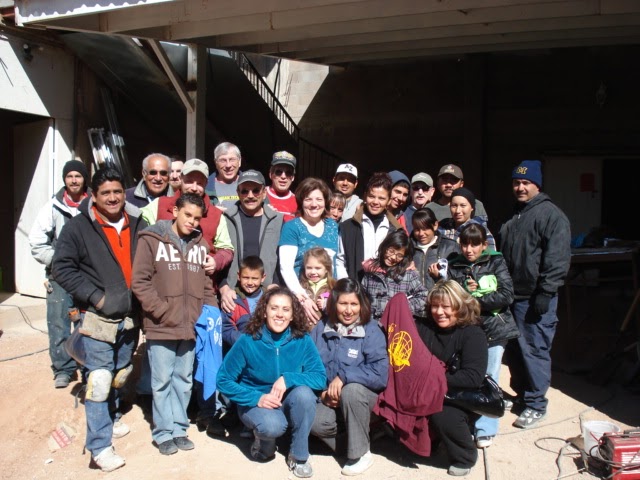
This picture was taken on the last day of our stay in Mexico. The team from CMFMC is sprinkled among the great people of Spring of Life FMC in Nogales, Sonora, Mexico.
01 February 2011
In Jail in Mexico
Over the course of my life I have visited people incarcerated in jail. Every visit has been through a glass screen and over a phone. Today was different. I went into a maximum security prison in Mexico.
Yesterday after church a man approached one of our missionary contacts and asked if any of the team from Michigan would like to accompany him on Monday for his ministry to the prison. Since we're out of our comfort zone, why not. I agreed to go.
Today, Hector arrived about 1:30 and wanting to know if I was ready. I changed my clothes, and grabbed my Bible and off we went. I wasn't sure what I was going to be asked to do. But preaching was a high possibility.
The prison is about 5 miles south of the church we are working on. It doesn't have the barbed wire of Michigan prisons, but the guard at the gate meets you with an AR-15 or M-16. Getting in proved to be easy, and thanks be to God, so was getting out.
The journey in the prison was through the prison yard to a church or chapel building. When we arrived the prisoners were singing music. The sound was different from yesterday at church. The church mostly sings songs translated into spanish from Passion, or Hillsong, or Chris Tomlin. The prison church was singing stuff that had a south of the border sound.
I was asked to preach and I went through the story in Mark 2 of Jesus healing the paralytic man. My preaching went for about 15 minutes. I turned to the interpreter and said, I think that is it. He said, oh, we have about another hour. We turned to the text and began digging deeper. The interchange was lively and beautiful. The attentive stance of the men was a gift of grace. Mark described Jesus as being at home or in the house in Caparenum, he was "in the house" within the prison.
After the sermon I prayed for these men; a great priviledge. They had a benediction and then greetings. Most came up and shook my hand and gave me a big hug. I have no thought that I added much to the Biblical understanding of the men within the prison. They have a small seminary and know their Bible's well. I have a sense that Jesus welcomed me in that place, that I stood in the house of God, a preacher, a confessor, a vessel, and mostly a recepient of God's grace.
As I walked out Hector passed me an item that the prisoners had given him, a small pepper mill. Inscribed on it was San Lucas (Gospel of Luke) 1.37 - "For nothing is impossible with God."
Indeed. Thanks be to God.
Yesterday after church a man approached one of our missionary contacts and asked if any of the team from Michigan would like to accompany him on Monday for his ministry to the prison. Since we're out of our comfort zone, why not. I agreed to go.
Today, Hector arrived about 1:30 and wanting to know if I was ready. I changed my clothes, and grabbed my Bible and off we went. I wasn't sure what I was going to be asked to do. But preaching was a high possibility.
The prison is about 5 miles south of the church we are working on. It doesn't have the barbed wire of Michigan prisons, but the guard at the gate meets you with an AR-15 or M-16. Getting in proved to be easy, and thanks be to God, so was getting out.
The journey in the prison was through the prison yard to a church or chapel building. When we arrived the prisoners were singing music. The sound was different from yesterday at church. The church mostly sings songs translated into spanish from Passion, or Hillsong, or Chris Tomlin. The prison church was singing stuff that had a south of the border sound.
I was asked to preach and I went through the story in Mark 2 of Jesus healing the paralytic man. My preaching went for about 15 minutes. I turned to the interpreter and said, I think that is it. He said, oh, we have about another hour. We turned to the text and began digging deeper. The interchange was lively and beautiful. The attentive stance of the men was a gift of grace. Mark described Jesus as being at home or in the house in Caparenum, he was "in the house" within the prison.
After the sermon I prayed for these men; a great priviledge. They had a benediction and then greetings. Most came up and shook my hand and gave me a big hug. I have no thought that I added much to the Biblical understanding of the men within the prison. They have a small seminary and know their Bible's well. I have a sense that Jesus welcomed me in that place, that I stood in the house of God, a preacher, a confessor, a vessel, and mostly a recepient of God's grace.
As I walked out Hector passed me an item that the prisoners had given him, a small pepper mill. Inscribed on it was San Lucas (Gospel of Luke) 1.37 - "For nothing is impossible with God."
Indeed. Thanks be to God.
10 January 2011
Mission To Nogales
January 29th I will be joining 5 others from CMFMC on a trip to Nogales, Sonoara, Mexico. We will be in Nogales until the 4th of February and return to central Michigan on the 5th. On the trip we will be connecting and working with Spring of Life Church, a Free Methodist Ministry. Here's a description about the church that came from a person on the ground in Nogales:
Spring of Life
Pastor Jaun Carlos was featured in a write-up in Light and Life Magazine.
Our work at Spring of Life will be to continue work on the building. In the spring of 2010 they had a massive mud slide that crashed through a wall portion of the church building and diverted their attention and resources to repairing portions of the building. From what we've heard we may be tasked with finishing this repair work and/or moving onto other projects that have been awaiting action.
This trip has been on the radar for a while. Last spring when Haiti endured their tremendous earthquake the Lord began doing a work in many hearts at CMFMC. There was a spirit that said, we need to be involved in responding. We did through our giving and prayers, our interest. We also felt the Lord leading us send and go.
After the earthquake three of us attended a training event hosted at Free Methodist headquarters in Indianapolis. The training focused on how to lead a short-term missions trip. The heart of the church was open and available and wanting to serve. We heard at HQ that the window of opportunity in Haiti was small. Though the need is great, the ability to move people in, about, and out was at low capacity. The people at HQ displayed great sensitivity toward the need and leadership of the Haitian church in knowing the best way to respond and help with Haiti.
As our training session ended in Indy, we were given a list of needs that existed, both in Haiti and around the world. As we continued to talk with HQ they continued to mention Nogales as a location that we should consider. By October we were ready to commit to the idea.
November found our team taking formation. People expressed interest, people discovered what it was going to cost, what it was going to take physically, emotionally, spiritually. In the end our team has become a team of 6 who are going, and a support team that includes the church here and innumerable people in our circles of life.
Along the journey we have watched the Lord do some amazing things. We had an operational budget that looked insurmountable. We've discovered that with some effort on our part in fund raising, some generous hearts have responded and the resources needed for the project are being provided - our Lord provides. We've watched people display skills and abilities that weren't being tapped in this way before. Of great joy is the leadership of our team leader Joel Brookens. He's done a good job of keeping many self-starters working as a team. He's been a little like Jesus with a group of disciples who have a host of ideas and he's been tasked with keeping us focused.
Our lone female team member, Shelly Miller, has displayed an entrepreneurial ability that has shaken the tree. She's like the lady who asks Jesus for healing for her son and won't take no for an answer. When Jesus says that he's been sent to the house of David and she's not in it, the lady says, that even the dogs under the table get something from the table - Jesus says she has much faith. Shelly has led our team in being persistent like this lady, and the fruit is awaiting action.
Though our team is small, there have been countless from the church who have chipped in at some of our fundraisers, who are praying for us, who are encouraging us along the way. Our families have been supportive and made contributions of time (our absence from them), thought, energy and encouragement. Some have expressed concern about border security, this has prompted us to think through the process well. There is a great inclusion that makes this team possible.
We've also discovered that preparing for a mission outside our borders has led us to mission at home. One of our first "fund raising" events was a hot chocolate and cookie stand in downtown Mt. Pleasant during the Dickens' Christmas Festival parade. We asked for donations for the hot drinks and cookies, we didn't raise a lot of money. However we did interact with our community, we told what we were doing and why, we had an opportunity to bless others, we invited the broader community to join us in mission. We found that being there, blessing others with hot drinks, displaying our mission and telling our story, was giving witness to Jesus, who came to earth because he loves the people in Mt. Pleasant and in Nogales.
We've got one more fundraiser ahead of us and then the trip. The Lord has surprised us, blessed us, led us. With great anticipation our team is looking forward to carrying out the work of prayer and serving in Nogales.
To the readers of this blog, I invite you to join our mission, in prayer especially. Gifts of monetary resources are also welcomed. You could send those to Central Michigan Free Methodist Church, 6012 S. Mission, Mt. Pleasant, MI 48858. Note that it's for Mexico. Any gift you'd give would be used for the work project. We are praising the Lord for his provision and for the grace that He has showered upon us through the beautiful hands of His Church.
Spring of Life
Pastor Jaun Carlos was featured in a write-up in Light and Life Magazine.
Our work at Spring of Life will be to continue work on the building. In the spring of 2010 they had a massive mud slide that crashed through a wall portion of the church building and diverted their attention and resources to repairing portions of the building. From what we've heard we may be tasked with finishing this repair work and/or moving onto other projects that have been awaiting action.
This trip has been on the radar for a while. Last spring when Haiti endured their tremendous earthquake the Lord began doing a work in many hearts at CMFMC. There was a spirit that said, we need to be involved in responding. We did through our giving and prayers, our interest. We also felt the Lord leading us send and go.
After the earthquake three of us attended a training event hosted at Free Methodist headquarters in Indianapolis. The training focused on how to lead a short-term missions trip. The heart of the church was open and available and wanting to serve. We heard at HQ that the window of opportunity in Haiti was small. Though the need is great, the ability to move people in, about, and out was at low capacity. The people at HQ displayed great sensitivity toward the need and leadership of the Haitian church in knowing the best way to respond and help with Haiti.
As our training session ended in Indy, we were given a list of needs that existed, both in Haiti and around the world. As we continued to talk with HQ they continued to mention Nogales as a location that we should consider. By October we were ready to commit to the idea.
November found our team taking formation. People expressed interest, people discovered what it was going to cost, what it was going to take physically, emotionally, spiritually. In the end our team has become a team of 6 who are going, and a support team that includes the church here and innumerable people in our circles of life.
Along the journey we have watched the Lord do some amazing things. We had an operational budget that looked insurmountable. We've discovered that with some effort on our part in fund raising, some generous hearts have responded and the resources needed for the project are being provided - our Lord provides. We've watched people display skills and abilities that weren't being tapped in this way before. Of great joy is the leadership of our team leader Joel Brookens. He's done a good job of keeping many self-starters working as a team. He's been a little like Jesus with a group of disciples who have a host of ideas and he's been tasked with keeping us focused.
Our lone female team member, Shelly Miller, has displayed an entrepreneurial ability that has shaken the tree. She's like the lady who asks Jesus for healing for her son and won't take no for an answer. When Jesus says that he's been sent to the house of David and she's not in it, the lady says, that even the dogs under the table get something from the table - Jesus says she has much faith. Shelly has led our team in being persistent like this lady, and the fruit is awaiting action.
Though our team is small, there have been countless from the church who have chipped in at some of our fundraisers, who are praying for us, who are encouraging us along the way. Our families have been supportive and made contributions of time (our absence from them), thought, energy and encouragement. Some have expressed concern about border security, this has prompted us to think through the process well. There is a great inclusion that makes this team possible.
We've also discovered that preparing for a mission outside our borders has led us to mission at home. One of our first "fund raising" events was a hot chocolate and cookie stand in downtown Mt. Pleasant during the Dickens' Christmas Festival parade. We asked for donations for the hot drinks and cookies, we didn't raise a lot of money. However we did interact with our community, we told what we were doing and why, we had an opportunity to bless others, we invited the broader community to join us in mission. We found that being there, blessing others with hot drinks, displaying our mission and telling our story, was giving witness to Jesus, who came to earth because he loves the people in Mt. Pleasant and in Nogales.
We've got one more fundraiser ahead of us and then the trip. The Lord has surprised us, blessed us, led us. With great anticipation our team is looking forward to carrying out the work of prayer and serving in Nogales.
To the readers of this blog, I invite you to join our mission, in prayer especially. Gifts of monetary resources are also welcomed. You could send those to Central Michigan Free Methodist Church, 6012 S. Mission, Mt. Pleasant, MI 48858. Note that it's for Mexico. Any gift you'd give would be used for the work project. We are praising the Lord for his provision and for the grace that He has showered upon us through the beautiful hands of His Church.
23 July 2010
A provocative quote
My Bishop speaking about leadership in the local church at a recent gathering offered the following assessment:
"We have a historical commitment to democracy, but democracy is inherently problematic for the church . . . it's clearly not right . . . democracy guarantees the right to say rude things. We need spiritual leadership, not democratic leadership."
"We have a historical commitment to democracy, but democracy is inherently problematic for the church . . . it's clearly not right . . . democracy guarantees the right to say rude things. We need spiritual leadership, not democratic leadership."
08 July 2010
Annual Conference
Friday, July the 10th is the North Michigan Annual Conference.
The Delegates and Pastors of the churches in the North Michigan Free Methodist family will gather for worship, prayer, encouragement, and discerning as to how we should follow Jesus together.
Your prayers are much appreciated. As always, I am hopeful for a conference that celebrates, challenges and in communion with Christ, anticipates tomorrow.
The Delegates and Pastors of the churches in the North Michigan Free Methodist family will gather for worship, prayer, encouragement, and discerning as to how we should follow Jesus together.
Your prayers are much appreciated. As always, I am hopeful for a conference that celebrates, challenges and in communion with Christ, anticipates tomorrow.
04 June 2010
Mirror To The Church
Yesterday I received a package of books from my cousin Joel. One of the books caught my immediate attention - Mirror To the Church; Resurrecting Faith after Genocide in Rwanda. The book is by Emmanuel Katongole, a Catholic priest of the Kampala Archdiocese, Uganda, and an associate professor of theology at Duke Divinity School. Katongole is helped in the writing by Jonathan Wilson-Hartgrove, however it is chiefly Katongole's voice that comes through in the story.
While the subtitle speaks of reconstructing faith after an event, the reader finds much of the work is focused on describing the stories that led Rwanda to the place where 800,000 people were murdered by their neighbors, friends, relatives, fellow church members in the country of Rwanda. In the last chapter Katongole will write, "Any resurrection of the church as the body of Christ must begin with lament, which is an honest look at the brokenness of the church. Without lament we move on too quickly to reconstruction. (p.164)"
Katongole says for resurrection we must have forgiveness and a truthful memory, "including the honest admission of failure." This honest confession isn't meant to "hang onto their mummified skeletons because we are afraid of the unknown future. (p.165)" "But lament brings us to the breaking point . . . [so that] even in the midst of what appears to be dead, God can issue a miracle of resurrection. (p.165-168)"
Katongole asks for the people of God to be given to Memory, Mirror and Mission. (p.169)
Katongole's work has a prophetic voice to the church, the world and myself. I am thankful for the prophet.
While the subtitle speaks of reconstructing faith after an event, the reader finds much of the work is focused on describing the stories that led Rwanda to the place where 800,000 people were murdered by their neighbors, friends, relatives, fellow church members in the country of Rwanda. In the last chapter Katongole will write, "Any resurrection of the church as the body of Christ must begin with lament, which is an honest look at the brokenness of the church. Without lament we move on too quickly to reconstruction. (p.164)"
Katongole says for resurrection we must have forgiveness and a truthful memory, "including the honest admission of failure." This honest confession isn't meant to "hang onto their mummified skeletons because we are afraid of the unknown future. (p.165)" "But lament brings us to the breaking point . . . [so that] even in the midst of what appears to be dead, God can issue a miracle of resurrection. (p.165-168)"
Katongole asks for the people of God to be given to Memory, Mirror and Mission. (p.169)
- "Memory - as we take seriously the history of Rwanda and the tragic failure of the church to offer a baptism that ran deeper than tribalism." Much of the book describes places and people who did not stand up to the genocide, many contributed to killing.
- "Mirror - as we see in this story how resurrection happens in fresh interruptions of the so-called natural identities and patterns of life that we have assumed to be normal." Katongole describes four biblical stories, three of which he asserts fall short of interrupting the flow of the kingdoms of this world and which tend to be the ways in which most of the church does its work. The fourth story is the story of Mary who anoints Jesus for his burial before he stands before Pilate. Mary interrupts the pattern of life and Katongole asks a perceptive question with regard to her story. He notes that Jesus said wherever his gospel would be preached what she did would be part of the story. Katongole says, "I can't remember a single evangelist summarizing the gospel message in a way that included Mary's story."(p.114) Katongole includes stories of people who have interrupted the flow of church and society to declare that they belong to the Kingdom of Christ.
- "Mission - as we realize a new and urgent call to create and become the mixed-up people whose allegiance to our national, tribal, ethnic or racial identities is suspect." Early in the work Katongole recounts a question and answer that took place among assembled church leaders: "Are you saying that the blood of tribalism is deeper than the waters of baptism? One leader answered, Yes it is." (p.22)
Katongole's work has a prophetic voice to the church, the world and myself. I am thankful for the prophet.
25 March 2010
In Indy
Today I'm in Indianapolis with two guys from the church. We've come down for a training seminar sponsored by VISA ministries, part of Free Methodist World Missions.
The crowd for this early training is somewhere around 75.
The largest crowd I've seen at a training event at Indy.
There looks to be a great deal of interest in the church to go in the name of Jesus.
It's going to be a great weekend.
The crowd for this early training is somewhere around 75.
The largest crowd I've seen at a training event at Indy.
There looks to be a great deal of interest in the church to go in the name of Jesus.
It's going to be a great weekend.
Subscribe to:
Posts (Atom)